
How to Use an Installment Loan for a Car Repair Bill
Turn a surprise repair quote into a fixed monthly payment. Learn how to use an installment loan to spread out a large car repair bill and protect your budget.

A $2,800 transmission replacement or a $1,500 catalytic converter can turn a routine week into a financial emergency. When the mechanic hands you a repair estimate that exceeds your available cash, the question is not whether you need the car fixed (you almost certainly do), but how to pay for it without draining every account or maxing out a credit card. For many drivers, an installment loan offers a structured path: you borrow a specific amount, repay it in fixed monthly installments, and keep your budget intact while your car gets back on the road. This guide walks through how to use an installment loan to spread out a large car repair bill, from evaluating the quote to matching the loan term to your repayment capacity and avoiding the common traps that turn a smart fix into a long-term debt burden.
Why a Car Repair Bill Is a Classic Installment Loan Use Case
Large repair bills share three traits that make them well-suited to installment financing: they are unexpected, they are non-negotiable for most drivers, and they arrive as a single lump sum. A single-payment cash advance or payday loan requires you to repay the entire amount plus fees on your next payday, which rarely aligns with a repair bill that is several times your monthly disposable income. An installment loan, by contrast, splits the principal into equal payments over a set number of months, typically three to twenty-four, and each payment includes both principal and interest. That structure turns a $3,000 shock into, for example, twelve payments of roughly $270, depending on the annual percentage rate (APR) the lender quotes.
The key distinction is cash flow timing. A repair shop wants payment when the work is done. Your paycheck arrives on a schedule. An installment loan bridges that gap by letting you convert a one-time obligation into a predictable line item in your monthly budget. For drivers with less-than-perfect credit, this can be especially valuable because many installment lenders evaluate the whole picture (income, existing obligations, and sometimes alternative data) rather than relying solely on a credit score. If you are exploring same-day funding options, a resource like same-day installment loans with direct deposit to Chime can explain how faster disbursement works when the repair shop needs payment quickly.
It also helps to understand what an installment loan is not. It is not a line of credit you can reuse, and it is not a lease or a credit card. It is a closed-end loan with a fixed principal, a fixed term, and a fixed payment schedule. That predictability is the feature that makes it useful for a repair bill, because you know exactly what you owe and when it is due.
Getting a Written Repair Estimate Before You Borrow
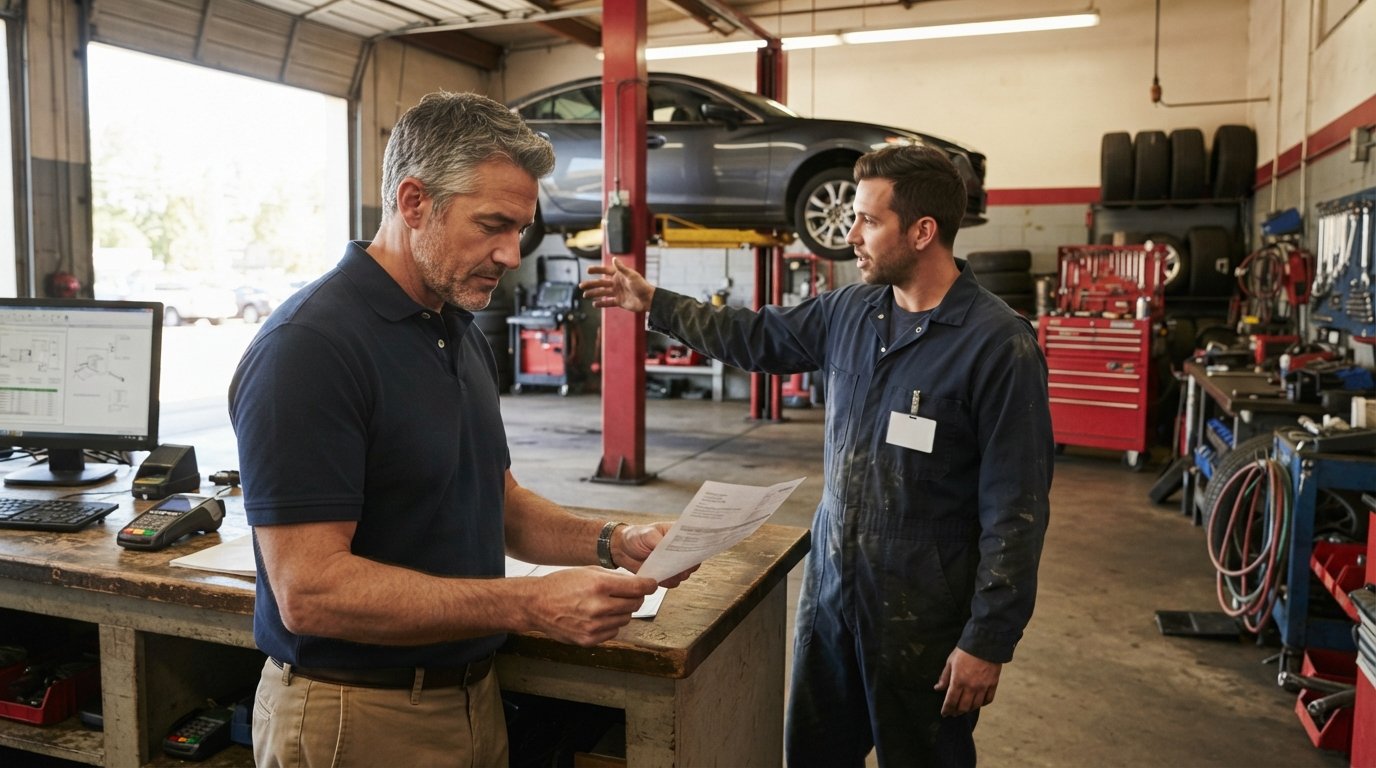
Before you fill out any loan request, get the repair estimate in writing. A verbal quote of "about three grand" is not a number you can build a loan around. Ask the shop for an itemized estimate that separates parts, labor, taxes, and any diagnostic fees. This document serves two purposes: it tells you the exact amount to request (borrowing too much means paying interest on money you do not need), and it gives you leverage to compare shops if the first quote seems high.
Review the estimate for items you can defer. A failing water pump and a worn serpentine belt may be listed together, but if the belt can wait a month while the pump cannot, you may be able to reduce the amount you finance. Similarly, ask whether the shop offers any payment plans of its own; some chains offer zero-interest promotional financing that could beat a loan. If the shop does not, the written estimate becomes your borrowing target.
Build in a small buffer, but not a large one. Repair estimates sometimes grow once the mechanic gets inside the engine, so adding 10 to 15 percent to the financed amount can prevent a second loan request mid-repair. Anything beyond that margin means you are paying interest on money that will likely sit unused. Keep the estimate and any revised invoices together so you can document the actual cost if the final bill differs from the original quote.
Matching the Loan Term to Your Repayment Capacity
The single most important decision in installment loan borrowing is the term length. A longer term lowers your monthly payment but increases the total interest you pay. A shorter term does the opposite. The right term is the shortest one whose monthly payment fits comfortably within your budget after accounting for rent, utilities, food, insurance, and existing debt payments. A common guideline is to keep total debt payments below 36 percent of gross monthly income, though that is a ceiling, not a target.
Here is a practical framework for choosing a term:
- Calculate your monthly surplus. Subtract essential expenses and existing minimum debt payments from your take-home pay. The result is the maximum you can comfortably dedicate to a new loan payment.
- Divide the repair amount by that surplus. If you can spare $250 per month and the repair is $3,000, a 12-month term is the shortest that fits (ignoring interest).
- Add interest and re-check. At a 24 percent APR, a 12-month $3,000 loan costs about $284 per month. If that exceeds your surplus, extend to 18 or 24 months and compare the total cost.
- Stress-test the payment. Ask yourself whether you could still make the payment if you lost overtime or had a minor emergency. If not, choose a longer term or a smaller loan.
That stress test matters because the goal is not just to fix the car but to avoid a second crisis when the first loan payment comes due. Lenders in the AdvanceCash network, for example, present offers with defined terms and APRs so you can compare monthly payments side by side. You are never obligated to accept an offer, which means you can request options and choose the term that genuinely fits rather than the first one presented.
Understanding the True Cost of Spreading Out the Bill
Interest is the price of convenience, and with installment loans it compounds over the life of the loan. A $3,000 repair financed at 18 percent APR over 12 months costs about $275 per month and roughly $300 in total interest. Stretch that to 24 months and the payment drops to about $150, but total interest rises to nearly $600. The difference is not trivial: doubling the term roughly doubles the interest cost even though the principal is identical.
Always compare offers using the APR, not just the monthly payment or the finance charge. The APR incorporates the interest rate and most fees, giving you an apples-to-apples number. A loan with a lower monthly payment but a much higher APR can cost far more overall. Request the total repayment amount (principal plus all interest and fees) in writing before you sign, and divide it by the number of payments to sanity-check the monthly figure.
Also watch for prepayment penalties. Some lenders charge a fee if you pay the loan off early, which removes the main advantage of choosing a longer term (the ability to pay it down faster if your finances improve). If early payoff is important to you, ask specifically whether the lender charges a penalty and get the answer in writing. A loan without a prepayment penalty gives you flexibility: you can make the scheduled payment in lean months and pay extra when you have surplus cash, reducing total interest.
When an Installment Loan Beats a Single-Payment Advance
Single-payment advances, including payday loans, are designed for short gaps between paychecks, not for multi-thousand-dollar repairs. A typical payday loan of $500 with a $75 fee translates to an APR in the triple digits when annualized, and the full balance comes due on your next payday. If you cannot repay it then, you roll it over and incur another fee, which is how small advances become large debts. Using a payday loan for a $3,000 repair would require multiple loans or an unmanageable single repayment.
An installment loan is generally the better fit when the amount is large relative to your monthly income, when you need more than one pay cycle to repay, and when you want a fixed schedule you can plan around. The trade-off is that you will pay interest over a longer period, but that interest buys predictability and avoids the rollover trap. For repairs under a few hundred dollars that you can repay within two weeks, a single-payment option might be cheaper; for anything larger, the installment structure almost always wins on total cost and risk.
If you are weighing options, a plain-language guide to connecting with short-term lenders online can help you understand how request forms work and what to expect from third-party lenders. Remember that AdvanceCash.com and similar services are connection platforms, not direct lenders; the loan terms, rates, and approval decisions come from the lender you ultimately choose. That distinction matters because it means you should compare the actual offers you receive, not just the platform you used to request them.
Avoiding a Second Loan If the Repair Cost Grows
Repair costs have a way of growing. The mechanic finds a cracked head gasket while replacing the timing belt, or the brake job reveals worn calipers. If you financed the original estimate exactly, a mid-repair increase can leave you short and tempted to take out a second loan. Two concurrent installment loans strain your budget and increase the risk of missed payments, which can damage your credit score and trigger late fees.
There are three practical ways to avoid this trap. First, build the 10 to 15 percent buffer mentioned earlier into the original loan amount, so modest overruns are already covered. Second, ask the shop to call you before performing any work beyond the estimate; a reputable shop will do this anyway, and it gives you the chance to approve or defer the extra work. Third, if the increase is large, consider a loan modification or a small additional loan only after confirming the first lender allows it, rather than stacking a second full-size loan on top of the first.
It also helps to keep the repaired car maintained after the loan is paid off. A modest maintenance budget (oil changes, brake checks, fluid flushes) reduces the chance of another large repair while you are still repaying the first loan. Responsible borrowing means treating the installment loan as a bridge, not a permanent financing habit, and using the breathing room it creates to rebuild your emergency savings so the next repair does not require borrowing at all.
Spreading out a large car repair bill with an installment loan comes down to preparation and discipline: get a written estimate, borrow only what the repair requires (plus a small buffer), choose the shortest term your budget can comfortably handle, compare APRs and total repayment costs, and confirm there is no prepayment penalty. Do those things, and a painful repair bill becomes a manageable monthly payment instead of a financial spiral.